 By nguyentiendung24101994
 Have you ever brushed off a new dark spot on your skin as ‘just another sign of getting older’? Most of us have. But what if that seemingly harmless mark on your hands, face, or arms is actually a crucial message your body is sending you? While many brown patches are indeed benign age spots, medical experts are increasingly urging people to look closer, because some look-alikes carry implications far more significant than simple aesthetics. What might appear to be a minor cosmetic change could, in fact, be a signal that warrants prompt evaluation. That’s why understanding the specific indicators dermatologists advise watching for is so important—and by the time you finish this article, you’ll have a practical checklist ready for your next self-skin examination.
Decoding Your Skin: The Truth About Age Spots After 50
Often referred to as solar lentigines, age spots are a common consequence of decades of sun exposure, leading to the formation of melanin clusters in the skin’s upper layers. These typically manifest as flat, round or oval patches, ranging in color from tan to dark brown or black. They are most frequently found on sun-exposed areas like the back of the hands, forearms, face, and shoulders.
These spots tend to emerge gradually and maintain a consistent size and color over many years. They feel smooth to the touch and possess clearly defined edges. While they can contribute to an uneven skin tone, age spots are fundamentally benign and pose no risk of transforming into cancer on their own. It’s quite normal for many adults over 60 to have several of these, simply reflecting a lifetime of cumulative sun exposure rather than indicating any current health concern.
The American Academy of Dermatology highlights that age spots become exceptionally prevalent after middle age because the skin’s natural ability to repair daily sun damage diminishes over time. Despite their harmless nature, their presence serves as a clear, visual reminder of significant UV exposure throughout an individual’s life.
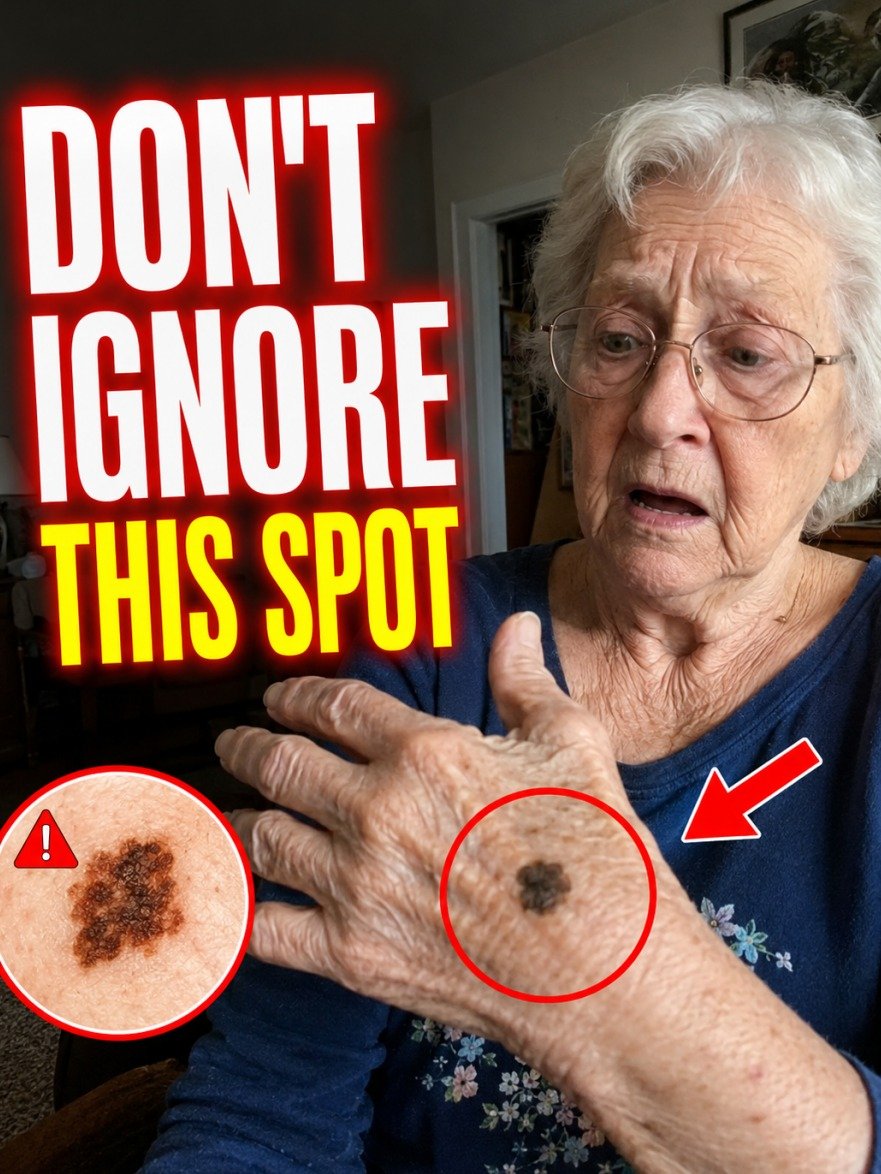
When a Dark Spot Demands Immediate Attention
It’s crucial to understand that not every dark mark on your skin behaves in the same predictable way. Some spots will begin to display irregular characteristics that clearly distinguish them from the surrounding skin. Experts consistently stress that the critical factor is observing any change or distinct difference, rather than automatically assuming every new mark is cause for alarm.
The ABCDE Rule: Your Dermatologist’s Secret Weapon
Both the American Academy of Dermatology and the Skin Cancer Foundation champion the ABCDE rule as an incredibly straightforward yet powerful method for evaluating pigmented spots. Here’s a breakdown of what each letter signifies in practical terms:
- A – Asymmetry: Imagine drawing an invisible line right through the center of the spot. If the two resulting halves don’t perfectly mirror each other in shape or size, this unevenness is a significant indicator to observe.
- B – Border: Carefully examine the edges. Typically, harmless age spots feature smooth, crisp, and well-defined boundaries. Spots that warrant a professional check often exhibit blurry, scalloped, notched, or poorly defined edges that seem to gradually blend into the surrounding skin.
- C – Color: While age spots usually maintain a single, consistent shade, suspicious spots might display multiple different colors simultaneously. This could include varying patches of light brown, dark brown, black, and sometimes even unexpected areas of red, white, or blue.
- D – Diameter: Many potentially concerning spots will measure larger than 6 millimeters across, which is roughly the size of a standard pencil eraser. However, it’s important to remember that some significant spots can appear smaller, particularly in their initial stages.
- E – Evolving: This is frequently cited as the most vital clue. Any spot that is noticeably growing, undergoing a change in shape, shifting its color, or developing new symptoms such as persistent itching, bleeding, or crusting, absolutely requires a professional evaluation.
Another incredibly useful concept to keep in mind is the